Posts

Showing posts with the label Ophelia

Changing Interpretations Over Time: Samuel Johnson

Image
It's not surprising that Shakespeare tops the league as the most quoted Englishman of all time; nor that  Hamlet is  the most often quoted of his plays. But Samuel Johnson, as well as being recognised amongst the most highly regarded literary figures in the eighteenth century, is regularly credited as being the second most-quoted after Shakespeare. And of course, most famous for compiling the first dictionary of the English Language in 1755. You can find out more about him here . Aside from being a handsome fellow, poet, lexicographer, essayist, and a big list of other things, he was a literary critic who wrote this about Hamlet: SAMUEL JOHNSON: from his edition of Shakespeare's plays, 1765 IF the dramas of Shakespeare were to be characterised, each by the particular excellence which distinguishes it from the rest, we must allow to the tragedy of Hamlet the praise of variety. The incidents are so numerous, that the argument of the play would make a long tale. The ...
Godwin's 2016 RSC Production: Act 5

Image
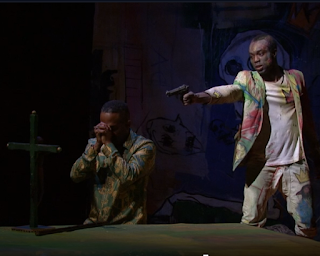
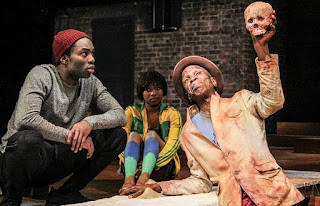
Act V plays out in around thirty two minutes (if you exclude the well-deserved applause at the end of the production). The music announcing the infamous gravediggers scene has a Calypso feel which sets an appropriately lighthearted, joyful even, and certainly irreverent tone - reinforced by the Gravedigger's ad lib of 'ya bastard' directed towards Yorick's skull. Hamlet's more measured response in contrast demonstrates his fascination with the physical processes of death and beyond. Ophelia's body, wrapped in a shroud, is carried in by Laertes. He lays her down tenderly by the grave and weeps over her form - echoing Ophelia's own lament for her father in the previous act. To the evident distress of all around, Laertes leaps right down into the grave as though he cannot bear to be physically separated from her. His action provokes what turns into an unseemly graveside brawl with Hamlet. Claudius hatches his plan for Hamlet's end with Laertes after...

Godwin's 2016 RSC production: Act Four

Image
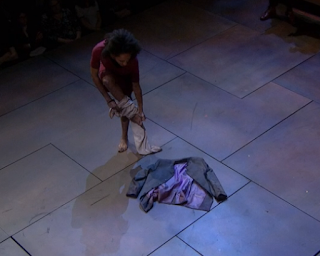
Ophelia makes Polonius 'present' in the absence of a body This is the shortest act of the production at just 28 minutes, but is full of pace and action. The stage is filled with ever-changing movement. Increasingly sinister and ominous music between scenes contributes to the building sense of threat, and the movement to different locations seems almost seamless; as though we are running through the castle with the characters. There are instructions, letters, machinations, plotting. Hamlet's arrest by a guard is very physical: he is thrown to the floor in a half-nelson submission hold. His insolent foot tapping and movement, and loose-limbed rebellious mocking of Claudius get the audience on side and there is much laughter - but his reactions seem those of a man who has run out of options and has nothing left to lose. Everything about Essiedu's appearance and manner is subversive; down to his shabby clothing and turned-up trousers - in such contrast to the costume...

Godwin's 2016 RSC Production: Act Three

Image
As we move into Act III (which is the longest part of this production running at 44 minutes), the stage is draped in enormous canvases, hanging down from the ceiling and spread across the floor. They suggest Hamlet's mania from their volume, and the preoccupations of his troubled mind in the calligramatic references to serpents, crowns and skulls. The concept of the tortured artist is constructed visually before it is enacted. Rosencrantz and Guildenstern's incompetence is suggested through their casual behaviour at the start of the scene, giving the idea that they don't really have their minds on the job, but are treating their time here as a holiday. Essiedu's Hamlet embarks on the 'To be or not to be' speech with a plaintive, questioning tone. You can explore the RSC's approach to this in more depth here . When Ophelia enters she is evidently still smarting from their previous exchange and attempts to return a large box of gifts and keepsakes fr...

Godwin's 2016 RSC Production: Act Two

Image
Act two is slightly shorter than the opening act, at 31 minutes. Might we add 'stingy' to our ideas of Polonius as he has to be persuaded to give more to his emissary? Ophelia's evident distress as she explains Hamlet's behaviour towards her greatly contrasts with her composure of the previous scene. She seems to emphasise the physical: that he 'held me hard' (II.1.87), and makes reference to the transformation that we are about to witness for ourselves, 'He falls to such perusal of my face/As a would draw it' (II.i.90-91). Now Polonius switches his own shoes, and bends down for Ophelia - reversing the dynamic of the previous scene. He seems a loving, if misguided, father attempting to do the best for his daughter. The embrace at the end of this exchange emphasises their closeness. The representation of Rosencrantz and Guildenstern as bumbling, white, camera and luggage-laden tourists makes them as conspicuously out of joint with their enviro...

Godwin's 2016 RSC Production: Act One

Image
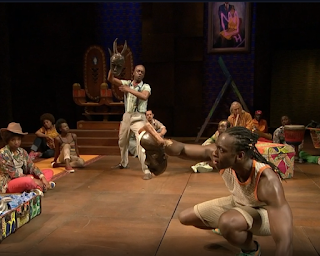
One of the unexpected benefits of lockdown has been the proliferation of free-to-air theatrical performances. The RSC's 2016 production with Paapa Essiedu as Hamlet has been shown on BBC iPlayer as part of their Culture in Quarantine access, and now forms part of our study. Act One runs for 41 minutes. The glimpse of Wittenberg student life emphasises the kind of world that Hamlet has 'lost', in addition to the loss of his father, as he arrives home. It also reminds the audience of his youth, and the celebratory moment of having a diploma conferred contrasts effectively with the grief later in Act One; the snapshot effect is also a signifier of change: a moment lost forever. Beyond this, the production has been described as the ' most traditional of interpretations '. For the first 'ghost' scene (though no ghost appears), the low, blue-black lighting means the actors are almost imperceptible at times - certainly difficult to pick out in the stage gloo...

Act V, scene i: That skull had a tongue in it and could sing once

Image
Here we are in the final act of Hamlet , and one of the most iconic scenes of the play - the bit with the skull! Clue: Not Hamlet. Two gravediggers are going about their business of digging a grave (that we immediately find out will be the final resting place of Ophelia) and making a few lighthearted observations as they do so. Though the graveyard setting foreshadows the tragedy that is about to beset Hamlet and the court, there is now a moment's pause in the chaotic hurtling towards a bitter end. It's probably worth a few words on 'comic relief' in Shakespearean tragedy. The stage direction gives us 'Enter two clowns'. Although 'clowns' in Shakespeare's time would have referred to simple country folk (in this instance two manual workers doing their job, not connected with the court),something of the modern meaning is inherent in their comic purpose at this moment in the drama. Somehow they achieve comedic banter from the burial of the dea...

Act IV, scene vii: Melodious lay to muddy death

Image
The final scene of Act IV sees  Claudius and Laertes concoct a murderous double-poisoning plot against Hamlet, and the Queen brings news of Ophelia's death. Before the scene begins it seems that the King has been telling Laertes his version of Polonius' death, along with his belief that he, Claudius, was his next target. Claudius gives a couple of reasons for not already having taken more extreme measures against Hamlet: firstly to please Gertrude, and then through a second reference to Hamlet's popularity with the people, the 'great love the general gender bear him' (IV.vii.18). But there is emphasis on action, and that action springs from Laertes, 'my revenge will come' (IV.vii.29); 'devise it so/That I might be the organ (IV.vii.68-69) from Laertes, and Claudius, in the business of egging him on, 'That we would do/We should do when we would' (IV.vii.117-118). Unlike Hamlet of course, who didn't avenge his father's death by k...

Act IV, scene v: The poison of deep grief

Image
Continuing the frenzied pace of this act, we meet the Queen and Horatio with a 'Gentleman' in mid conversation about Ophelia's grief-stricken state of mind and 'distract' behaviour. (Hamlet himself doesn't appear in the next three scenes.) Gertrude determines 'I will not speak with her' (IV.v.1) but is persuaded to 'Let her come in' (IV.iv.16) just fifteen lines later - after the indirect threat to Hamlet that Ophelia 'may strew/Dangerous conjectures in ill-breeding minds' (IV.v.14-15). There is evidently sufficient sense in the things that Ophelia says to cause trouble for the King. (It is worth remembering that the the handling of Polonius' death is causing political tensions and adding to the civil unrest.) Ophelia enacts being mad with grief, and matches the description that she 'Speaks much of her father' (IV.v.4), but does so mostly through song. She leaves just prior to the arrival of a livid Laertes, so...