Posts

Showing posts with the label Polonius

Changing Interpretations Over Time: G H Lewes

Image
I always like it when a man is introduced in reference to his more famous partner (though sadly it usually happens the other way round.) In this case, George Henry Lewes (1817-1878) is actually better known for being the partner or 'companion' of Mary Ann Evans - herself better known as George Eliot. By the time Eliot was writing, some female authors were  being published under their own names but  she chose to escape the stereotypes surrounding women's writing and its supposed limitations by choosing a male-sounding name. She also wished to have her fiction judged separately from her writing as an editor and literary critic. The magnificent  Middlemarch  is an epic summer holiday read if you need one. Martin Amis, eminent novelist in his own right, describes it as being 'the'  novel of the 19th century ', and a group of international critics decided that it was the best novel of all time  back in 2015. Quite a claim indeed. Anyway, I digress. We're...

Changing Interpretations Over Time: Samuel Taylor Coleridge

Image
Double whammy today: not one, but two extracts from the poet Samuel Taylor Coleridge (1772-1834), best known for the Rime of the Ancient Mariner and Kubla Khan  - which the online Encyclopedia Britannica labels 'two of the greatest poems in English literature'. He was a mover and shaker within the Romantic movement, and good mates with Wordsworth. It is probably worth reading a little more about the Romantics before you move on, since some of the ideology is reflected here in Coleridge's words. The British Library is a good place to start. S. T. COLERIDGE: from Lectures on Shakespeare , 1818 IN Hamlet he [Shakespeare] seems to have wished to exemplify the moral necessity of a due balance between our attention to the objects of our senses, and our meditation on the workings of our minds, - equilibrium between the real and the imaginary worlds. In Hamlet this balance is disturbed: his thoughts, and the images of his fancy, are far more vivid than his actual perce...

Godwin's 2016 RSC Production: Act Three

Image
As we move into Act III (which is the longest part of this production running at 44 minutes), the stage is draped in enormous canvases, hanging down from the ceiling and spread across the floor. They suggest Hamlet's mania from their volume, and the preoccupations of his troubled mind in the calligramatic references to serpents, crowns and skulls. The concept of the tortured artist is constructed visually before it is enacted. Rosencrantz and Guildenstern's incompetence is suggested through their casual behaviour at the start of the scene, giving the idea that they don't really have their minds on the job, but are treating their time here as a holiday. Essiedu's Hamlet embarks on the 'To be or not to be' speech with a plaintive, questioning tone. You can explore the RSC's approach to this in more depth here . When Ophelia enters she is evidently still smarting from their previous exchange and attempts to return a large box of gifts and keepsakes fr...

Godwin's 2016 RSC Production: Act Two

Image
Act two is slightly shorter than the opening act, at 31 minutes. Might we add 'stingy' to our ideas of Polonius as he has to be persuaded to give more to his emissary? Ophelia's evident distress as she explains Hamlet's behaviour towards her greatly contrasts with her composure of the previous scene. She seems to emphasise the physical: that he 'held me hard' (II.1.87), and makes reference to the transformation that we are about to witness for ourselves, 'He falls to such perusal of my face/As a would draw it' (II.i.90-91). Now Polonius switches his own shoes, and bends down for Ophelia - reversing the dynamic of the previous scene. He seems a loving, if misguided, father attempting to do the best for his daughter. The embrace at the end of this exchange emphasises their closeness. The representation of Rosencrantz and Guildenstern as bumbling, white, camera and luggage-laden tourists makes them as conspicuously out of joint with their enviro...

Godwin's 2016 RSC Production: Act One

Image
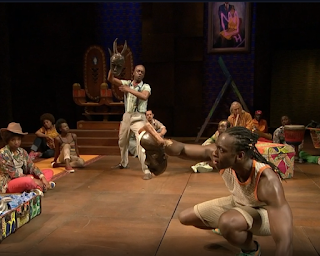
One of the unexpected benefits of lockdown has been the proliferation of free-to-air theatrical performances. The RSC's 2016 production with Paapa Essiedu as Hamlet has been shown on BBC iPlayer as part of their Culture in Quarantine access, and now forms part of our study. Act One runs for 41 minutes. The glimpse of Wittenberg student life emphasises the kind of world that Hamlet has 'lost', in addition to the loss of his father, as he arrives home. It also reminds the audience of his youth, and the celebratory moment of having a diploma conferred contrasts effectively with the grief later in Act One; the snapshot effect is also a signifier of change: a moment lost forever. Beyond this, the production has been described as the ' most traditional of interpretations '. For the first 'ghost' scene (though no ghost appears), the low, blue-black lighting means the actors are almost imperceptible at times - certainly difficult to pick out in the stage gloo...

Act IV, scene v: The poison of deep grief

Image
Continuing the frenzied pace of this act, we meet the Queen and Horatio with a 'Gentleman' in mid conversation about Ophelia's grief-stricken state of mind and 'distract' behaviour. (Hamlet himself doesn't appear in the next three scenes.) Gertrude determines 'I will not speak with her' (IV.v.1) but is persuaded to 'Let her come in' (IV.iv.16) just fifteen lines later - after the indirect threat to Hamlet that Ophelia 'may strew/Dangerous conjectures in ill-breeding minds' (IV.v.14-15). There is evidently sufficient sense in the things that Ophelia says to cause trouble for the King. (It is worth remembering that the the handling of Polonius' death is causing political tensions and adding to the civil unrest.) Ophelia enacts being mad with grief, and matches the description that she 'Speaks much of her father' (IV.v.4), but does so mostly through song. She leaves just prior to the arrival of a livid Laertes, so...

Act IV, sc iii: We fat ourselves for maggots

Image
The pacy, almost real-time movement continues into another short scene as Rosencrantz announces that they have brought Hamlet to the King. Claudius reveals something of Hamlet's popularity, which hasn't been directly alluded to before. 'He's lov'd of the distracted multitude' (IV.iii.4). Hamlet's wordplay also continues - in somewhat poor taste, perhaps. He refuses to give a straight answer to the question of where Polonius' body lies, but emphasises its corporeal nature as fodder for worms, and jokes that if it isn't found within a month then the King will be able to detect his decaying corpse and 'nose him as you go up the stairs' (IV.iii.36). It is at least a hint as to the location, and enables Claudius to dispatch his attendants in search of it. The air of melancholy and general futility of life that he expressed earlier in the play underlies sentiments such as 'we fat ourselves for maggots' (IV.iii.22). But death is ...

Act IV, scene ii: The King is a thing

Image
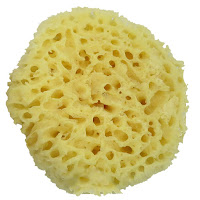
This is another very short scene, of less than thirty lines; the shortest in the entire play, in fact. Hamlet describes the body of Polonius as 'Safely stowed' in the opening line. It's an odd description: indicating something neatly stored or packed away - perhaps concealed - but with the suggestion of later use. Hamlet's speech is disordered and irrational. He speaks in non-sequiturs and riddles when Rosencrantz and Guildenstern arrive, emphasising his distrust of former friends in his depiction of them as foolish: mere sponges who 'soak up the king's countenance' but will get their just desserts when they are squeezed out 'dry' in the end. Gone is the iambic pentameter that has mostly shaped Hamlet's speech previously,  but there is an interesting use of double syntax or syntactic slide   at the end of the scene.  (This is where meaning is created in one line and then recreated differently in the next - one of my favourite th...

Act IV, scene i: Discord and dismay

Image
This scene is short, just 45 lines, and perhaps its primary plot purpose is to have Rosencrantz and Gildenstern despatched to hunt for Polonius' body, last seen being dragged off unceremonioulsy by Hamlet at the end of Act III to 'lug the guts into the neighbour room' (III.iv.214). But very importantly, we also see Gertrude's explanation to Claudius about Polonius' murder - the very thing that Hamlet has asked her not to do. Gertrude describes Hamlet's wild and violent madness as that of 'the sea and wind when both contend/Which is the mightier.' (IV.i.7-8). Claudius is strengthened in his resolve to send Hamlet to England. If you are interested in continuing to collect imagery of contagion, note that Claudius describes Hamlet as the embodiment of a 'foul disease' that has begun to 'feed even on the pith of life' (IV.i.21-23). An enraged Claudius registers 'discord and dismay' in what feels like a flippant couplet at the e...

Act III, scene iv: A rash and bloody deed

Image
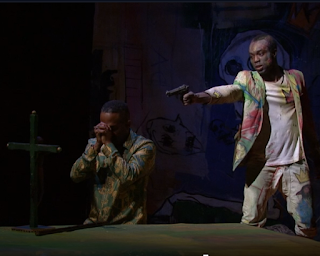
Now we reach the point of no return for Hamlet - the pivot on which the rest of the play turns. And there is plenty of drama. Having toyed with the idea of murder in the previous scene, his is driven to murderous action in this one - before his father's ghost reappears. The scene opens with Polonius' antagonistic imperatives to the Queen - about how to speak to her son, in order to 'lay home' aspects of his behaviour and 'tell him' that it will no longer be tolerated (III.iv.1-2) - before Polonius secretes himself behind the arras. But a suggestion that Gertrude has mediated on Hamlet's behalf hovers on the air, that she 'hath screen'd and stood between/Much heat and him' (III.iv.3-4). Hamlet, though, is evidently unaware of any such intercession. When he arrives, the dialogue with his mother provides what is possibly my favourite exchange of the play.  Queen Hamlet, thou has thy father much offended. Hamlet Mother, you have m...