Posts

Changing Interpretations Over Time: Hartley Coleridge
Image
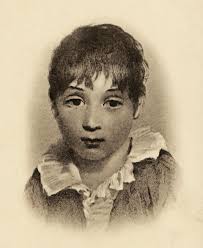
From father to son. Hartley Coleridge (1796-1849) is the eldest son of Samuel Taylor Coleridge, who followed in his father's footsteps by becoming a poet (though was also a teacher), and likewise wrote about Hamlet. It is generally accepted that he was not as successful in literary terms, or in life more generally, as his father. Perhaps burdened by the expectation of his famous name, and in the shadow of his father's genius, he is variously described as 'wayward', 'a failure'. 'melancholic' and 'solitary'. HARTLEY COLERIDGE: from Blackwood's Edinburgh Magazine , November 1828 Let us, for a moment, put Shakespeare out of the question, and consider Hamlet as a real person, a recently deceased acquaintance. In real life, it is no unusual thing to meet with characters every whit as obscure as that of the Prince of Denmark; men seemingly accomplished for the greatest actions, clear in thought, and dauntless in deed, still meditating mi...

Changing Interpretations Over Time: Samuel Taylor Coleridge

Image
Double whammy today: not one, but two extracts from the poet Samuel Taylor Coleridge (1772-1834), best known for the Rime of the Ancient Mariner and Kubla Khan  - which the online Encyclopedia Britannica labels 'two of the greatest poems in English literature'. He was a mover and shaker within the Romantic movement, and good mates with Wordsworth. It is probably worth reading a little more about the Romantics before you move on, since some of the ideology is reflected here in Coleridge's words. The British Library is a good place to start. S. T. COLERIDGE: from Lectures on Shakespeare , 1818 IN Hamlet he [Shakespeare] seems to have wished to exemplify the moral necessity of a due balance between our attention to the objects of our senses, and our meditation on the workings of our minds, - equilibrium between the real and the imaginary worlds. In Hamlet this balance is disturbed: his thoughts, and the images of his fancy, are far more vivid than his actual perce...

Changing Interpretations Over Time: Hazlitt

Image
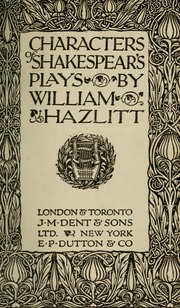
Fair 'catapulting' forward to the nineteenth century now as we meet William Hazlitt (1778-1830), probably best known for his essays, and hobnobbing with the Romantic poets like Wordsworth, Coleridge, Keats and Shelley - and not his spelling of 'Shakespeare'. He is also considered to be the first great English theatre critic. The extract below comes from Characters of Shakespear's Plays , published in 1817. Hamlet is a name; his speeches and sayings but the idle coinage of the poet's brain. What then, are they not real? They are as real as our own thoughts. Their reality is in the reader's mind. It is we who are Hamlet. This play has a prophetic truth, which is above that of history. Whoever has become thoughtful and melancholy through his own mishaps or those of others; whoever has borne about with him the clouded brow of reflection, and thought himself 'too much i' th' sun'; whoever has seen the golden lamp of day dimmed by envious...

Changing Interpretations Over Time: Goethe

Image
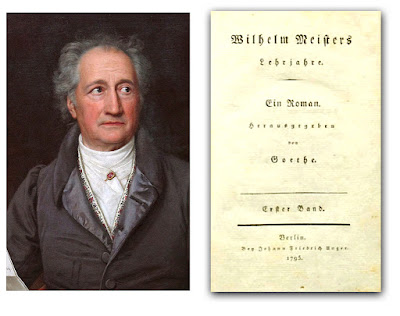
If nothing else, our foray into criticism of Hamlet is providing us with a who's who of literary greats in Europe. Next up is Johann Wolfgang von Goethe (1749-1832), widely considered to be Germany's greatest literary figure - and clearly a man who knew a thing or two about sporting a frock coat, judging by his picture. You may have come across him already as he is also credited with writing the first Bildungsroman in Willhelm Meister's Apprenticeship .  By the 1740s, Shakespeare's work had begun to be translated into German, and, by the end of the eighteenth century, had achieved great popularity and influence in Germany. In  Wilhelm Meister's Apprenticeship  the protagonist, Wilhelm sets out on his travels after being disillusioned in love - and is introduced to the works of Shakespeare by the character Jarno before playing the lead role in a theatrical production of Hamlet. Much discussion of Shakespeare's work takes place within the dialogue of t...

Changing Interpretations Over Time: Samuel Johnson

Image
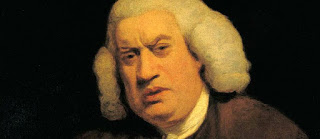
It's not surprising that Shakespeare tops the league as the most quoted Englishman of all time; nor that  Hamlet is  the most often quoted of his plays. But Samuel Johnson, as well as being recognised amongst the most highly regarded literary figures in the eighteenth century, is regularly credited as being the second most-quoted after Shakespeare. And of course, most famous for compiling the first dictionary of the English Language in 1755. You can find out more about him here . Aside from being a handsome fellow, poet, lexicographer, essayist, and a big list of other things, he was a literary critic who wrote this about Hamlet: SAMUEL JOHNSON: from his edition of Shakespeare's plays, 1765 IF the dramas of Shakespeare were to be characterised, each by the particular excellence which distinguishes it from the rest, we must allow to the tragedy of Hamlet the praise of variety. The incidents are so numerous, that the argument of the play would make a long tale. The ...

Changing Interpretations Over Time: Voltaire

Image
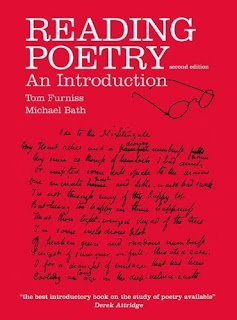
Over the next few weeks we are going to consider some different critical perspectives of Hamlet . First, it is worth considering why interpretation of the same words on the page and stage have come to be viewed so differently across the ages. There is a good explanation in one of my favourite books on poetry: ‘ Different historical periods have made very different assumptions about what literature is and have consequently come up with startlingly different accounts of the ‘same’ texts .. . historical pluralism can be graphically illustrated by the history of critical interpretations of a text such as Hamlet . In the four-hundred year period since it was written, critics and theatre producers have tried to solve the puzzle of Hamlet and have come up with a huge range of differering ‘solutions’. Each period has viewed the play differently, and critics within each period have disagreed over it. The actual text of the play - the words on the page or the stage - clearl...

A Word On Structure And Form

Image
In case you haven't had enough examination feedback, I'm sharing even more: this time on t he first part of the exam question which invited you to discuss the passage from Act 1 Scene 2, lines 65-120, exploring Shakespeare's use of language and its dramatic effects.  This scene is a gift, as it offers Hamlet’s first words and actions of the play. Because it is Shakespeare, of course they are rich with imagery and ideas that set up all sorts of themes and conflicts for the rest of the play - so there is plenty to discuss. You are interested in how Shakespeare shapes meaning through the interplay of language, form and structure . It is, in many ways, easier to deal with all three together, since that word 'interplay' is quite important. Form is really concerned with aspects of genre that appear within a text, as well as the 'form,' or type, of the text itself, in this case a play, and specifically, a Shakespearian tragedy. Form might also inclu...